




John William Watson1 
M, #19481, b. 23 May 1827, d. 30 January 1909
Last Edited=23 Jun 2024
John William Watson was born on 23 May 1827.2 He was the son of Sir William Henry Watson and Anne Armstrong.3 He married Margaret Godman Fitzpatrick, daughter of Patrick Persse Fitzpatrick, on 5 May 1859.2 He died on 30 January 1909 at age 81.1
He held the office of Justice of the Peace (J.P.)2 He lived at 65 Eccleston Square, London, England.2 He lived at Adderstone Hall, Belford, Northumberland, EnglandG.1
He held the office of Justice of the Peace (J.P.)2 He lived at 65 Eccleston Square, London, England.2 He lived at Adderstone Hall, Belford, Northumberland, EnglandG.1
Children of John William Watson and Margaret Godman Fitzpatrick
- Susan Dorothea FitzPatrick Watson-Armstrong4 d. 1961
- William Henry Armstrong Fitzpatrick Watson-Armstrong, 1st Baron Armstrong+1 b. 3 May 1863, d. 16 Oct 1941
Citations
- [S6] G.E. Cokayne; with Vicary Gibbs, H.A. Doubleday, Geoffrey H. White, Duncan Warrand and Lord Howard de Walden, editors, The Complete Peerage of England, Scotland, Ireland, Great Britain and the United Kingdom, Extant, Extinct or Dormant, new ed., 13 volumes in 14 (1910-1959; reprint in 6 volumes, Gloucester, U.K.: Alan Sutton Publishing, 2000), volume XIII, page 27. Hereinafter cited as The Complete Peerage.
- [S34] BP1970 page 104. See link for full details for this source. Hereinafter cited as. [S34]
- [S21] L. G. Pine, The New Extinct Peerage 1884-1971: Containing Extinct, Abeyant, Dormant and Suspended Peerages With Genealogies and Arms (London, U.K.: Heraldry Today, 1972), page 7. Hereinafter cited as The New Extinct Peerage.
- [S37] BP2003 volume 1, page 799. See link for full details for this source. Hereinafter cited as. [S37]
Margaret Godman Fitzpatrick1
F, #19482, d. 18 August 1922
Last Edited=23 Jun 2024
Margaret Godman Fitzpatrick was the daughter of Patrick Persse Fitzpatrick.1 She married John William Watson, son of Sir William Henry Watson and Anne Armstrong, on 5 May 1859.2 She died on 18 August 1922.1
From 5 May 1859, her married name became Watson.
From 5 May 1859, her married name became Watson.
Children of Margaret Godman Fitzpatrick and John William Watson
- Susan Dorothea FitzPatrick Watson-Armstrong3 d. 1961
- William Henry Armstrong Fitzpatrick Watson-Armstrong, 1st Baron Armstrong+1 b. 3 May 1863, d. 16 Oct 1941
Citations
- [S6] G.E. Cokayne; with Vicary Gibbs, H.A. Doubleday, Geoffrey H. White, Duncan Warrand and Lord Howard de Walden, editors, The Complete Peerage of England, Scotland, Ireland, Great Britain and the United Kingdom, Extant, Extinct or Dormant, new ed., 13 volumes in 14 (1910-1959; reprint in 6 volumes, Gloucester, U.K.: Alan Sutton Publishing, 2000), volume XIII, page 27. Hereinafter cited as The Complete Peerage.
- [S34] BP1970 page 104. See link for full details for this source. Hereinafter cited as. [S34]
- [S37] BP2003 volume 1, page 799. See link for full details for this source. Hereinafter cited as. [S37]
Patrick Persse Fitzpatrick1
M, #19483
Last Edited=16 Aug 2022
Children of Patrick Persse Fitzpatrick
- Margaret Godman Fitzpatrick+1 d. 18 Aug 1922
- Elizabeth Colthurst FitzPatrick+2 d. 6 Feb 1852
Citations
- [S6] G.E. Cokayne; with Vicary Gibbs, H.A. Doubleday, Geoffrey H. White, Duncan Warrand and Lord Howard de Walden, editors, The Complete Peerage of England, Scotland, Ireland, Great Britain and the United Kingdom, Extant, Extinct or Dormant, new ed., 13 volumes in 14 (1910-1959; reprint in 6 volumes, Gloucester, U.K.: Alan Sutton Publishing, 2000), volume XIII, page 27. Hereinafter cited as The Complete Peerage.
- [S35] BLG1965 volume 2, page 505. See link for full details for this source. Hereinafter cited as. [S35]
Elizabeth Soward1
F, #19484
Last Edited=17 Sep 2003
Child of Elizabeth Soward and Jonathan Cowx
- Beatrice Elizabeth Cowx1 b. 1863, d. 4 Nov 1934
Citations
- [S6] G.E. Cokayne; with Vicary Gibbs, H.A. Doubleday, Geoffrey H. White, Duncan Warrand and Lord Howard de Walden, editors, The Complete Peerage of England, Scotland, Ireland, Great Britain and the United Kingdom, Extant, Extinct or Dormant, new ed., 13 volumes in 14 (1910-1959; reprint in 6 volumes, Gloucester, U.K.: Alan Sutton Publishing, 2000), volume XIII, page 27. Hereinafter cited as The Complete Peerage.
J. Soward1
M, #19485
Last Edited=17 Sep 2003
Child of J. Soward
Citations
- [S6] G.E. Cokayne; with Vicary Gibbs, H.A. Doubleday, Geoffrey H. White, Duncan Warrand and Lord Howard de Walden, editors, The Complete Peerage of England, Scotland, Ireland, Great Britain and the United Kingdom, Extant, Extinct or Dormant, new ed., 13 volumes in 14 (1910-1959; reprint in 6 volumes, Gloucester, U.K.: Alan Sutton Publishing, 2000), volume XIII, page 27. Hereinafter cited as The Complete Peerage.
Lucy Taylor1
F, #19486
Last Edited=17 Sep 2003
Child of Lucy Taylor and Reverend Charles Thorpe England
- Lucy Kathleen England1 b. 12 Aug 1898, d. 1970
Citations
- [S6] G.E. Cokayne; with Vicary Gibbs, H.A. Doubleday, Geoffrey H. White, Duncan Warrand and Lord Howard de Walden, editors, The Complete Peerage of England, Scotland, Ireland, Great Britain and the United Kingdom, Extant, Extinct or Dormant, new ed., 13 volumes in 14 (1910-1959; reprint in 6 volumes, Gloucester, U.K.: Alan Sutton Publishing, 2000), volume XIII, page 27. Hereinafter cited as The Complete Peerage.
Luke Taylor1
M, #19487
Last Edited=17 Sep 2003
Child of Luke Taylor
Citations
- [S6] G.E. Cokayne; with Vicary Gibbs, H.A. Doubleday, Geoffrey H. White, Duncan Warrand and Lord Howard de Walden, editors, The Complete Peerage of England, Scotland, Ireland, Great Britain and the United Kingdom, Extant, Extinct or Dormant, new ed., 13 volumes in 14 (1910-1959; reprint in 6 volumes, Gloucester, U.K.: Alan Sutton Publishing, 2000), volume XIII, page 27. Hereinafter cited as The Complete Peerage.
Cecil James Drummond-Wolff1
M, #19488
Last Edited=27 Nov 2018
Cecil James Drummond-Wolff is the son of Rt. Hon. Sir Henry Drummond Wolff and Adeline Douglas.
He lived at Caplanne, Billère, Pau, FranceG.1 He lived at The Thatched Cottage, Bushey Park, County Wicklow, IrelandG.1
He lived at Caplanne, Billère, Pau, FranceG.1 He lived at The Thatched Cottage, Bushey Park, County Wicklow, IrelandG.1
Child of Cecil James Drummond-Wolff
- Zaida Cecile Drummond-Wolff+1 b. 27 Oct 1896, d. 15 Feb 1978
Citations
- [S6] G.E. Cokayne; with Vicary Gibbs, H.A. Doubleday, Geoffrey H. White, Duncan Warrand and Lord Howard de Walden, editors, The Complete Peerage of England, Scotland, Ireland, Great Britain and the United Kingdom, Extant, Extinct or Dormant, new ed., 13 volumes in 14 (1910-1959; reprint in 6 volumes, Gloucester, U.K.: Alan Sutton Publishing, 2000), volume XIII, page 27. Hereinafter cited as The Complete Peerage.
William George Armstrong, 1st and last Baron Armstrong of Cragside1
M, #19489, b. 26 November 1810, d. 27 December 1900
Last Edited=25 Jan 2013
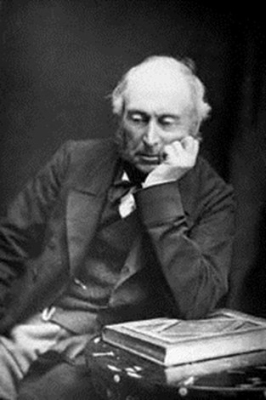
William Armstrong, 1st and last Baron Armstrong of Cragside2
He was educated at Grammar School, Bishop Auckland, County Durham, EnglandG.1 He was a partner in the law firm Donkin, Stable and Armstrong in 1833.4 In 1839 he constructed a water pressure wheel.4 In 1844 he constructed a hyrdo-electric machine.4 In 1846 he patented the hyraulic crane.4 He was appointed Fellow, Royal Society (F.R.S.) on 7 May 1846.1 He was the founder and Chairman of the Elswick-on-Tyne engineering works in 1847.1,4 In 1850 he invented the hydraulic pressure accumulator.4 In 1851 he designed submarine mines for the Crimean War.4 He invented the rifled bore breech-loading gun with cylinder, pantented his invention, and presented the patent to the nation.4 He was Engineer of Rifled Ordnance to War Department between 1858 and 1863, resigning after the government swtiched back to muzzle loading guns.1 He was appointed Knight Bachelor on 23 February 1859.1 He was appointed Companion, Order of the Bath (C.B.) on 25 March 1859.1 He graduated from Cambridge University, Cambridge, Cambridgeshire, EnglandG, in 1862 with a Doctor of Law (LL.D.)1 He graduated from Oxford University, Oxford, Oxfordshire, EnglandG, on 21 June 1870 with a Doctor of Civil Laws (D.C.L.)1 He held the office of High Sheriff of Northumberland in 1873.4 In 1880 The government switched back to breech loading guns, and he completed a 6 inch breech loading gun.4 In 1882 he established at shipyard at Elswick to build warships.4 He graduated from Durham University, Durham, County Durham, EnglandG, in 1882 with a Doctor of Civil Laws (D.C.L.)3 He was created 1st Baron Armstrong of Cragside, co. Northumberland [U.K.] on 6 July 1887.3 He graduated from Dublin University, Dublin, County Dublin, IrelandG, in 1892 with a honorary Master in Engineering (M.E.)3 In 1897 he merged his own business with those of Sir Joseph Whitworth at Openshaw, to make Whitworth guns.4 He has an extensive biographical entry in the Dictionary of National Biography.5

Citations
- [S6] G.E. Cokayne; with Vicary Gibbs, H.A. Doubleday, Geoffrey H. White, Duncan Warrand and Lord Howard de Walden, editors, The Complete Peerage of England, Scotland, Ireland, Great Britain and the United Kingdom, Extant, Extinct or Dormant, new ed., 13 volumes in 14 (1910-1959; reprint in 6 volumes, Gloucester, U.K.: Alan Sutton Publishing, 2000), volume I, page 218. Hereinafter cited as The Complete Peerage.
- [S4567] Bill Norton, "re: Pitman Family," e-mail message to Darryl Roger LUNDY (101053), 6 April 2010 and 19 April 2011. Hereinafter cited as "re: Pitman Family."
- [S6] Cokayne, and others, The Complete Peerage, volume I, page 219.
- [S21] L. G. Pine, The New Extinct Peerage 1884-1971: Containing Extinct, Abeyant, Dormant and Suspended Peerages With Genealogies and Arms (London, U.K.: Heraldry Today, 1972), page 7. Hereinafter cited as The New Extinct Peerage.
- [S18] Matthew H.C.G., editor, Dictionary of National Biography on CD-ROM (Oxford, U.K.: Oxford University Press, 1995), reference "Armstrong, William George, 1810-1900". Hereinafter cited as Dictionary of National Biography.
William Armstrong1
M, #19490, b. 1778
Last Edited=8 Apr 2004
William Armstrong was born in 1778.2
He was a corn merchant.2 He held the office of Alderman.1 He held the office of Mayor of Newcastle-upon-Tyne in 1850.2 He lived at Newcastle-upon-Tyne, Northumberland, EnglandG.1
He was a corn merchant.2 He held the office of Alderman.1 He held the office of Mayor of Newcastle-upon-Tyne in 1850.2 He lived at Newcastle-upon-Tyne, Northumberland, EnglandG.1
Children of William Armstrong and Anne Potter
- Anne Armstrong+2 d. 1 Jun 1828
- William George Armstrong, 1st and last Baron Armstrong of Cragside1 b. 26 Nov 1810, d. 27 Dec 1900
Citations
- [S6] G.E. Cokayne; with Vicary Gibbs, H.A. Doubleday, Geoffrey H. White, Duncan Warrand and Lord Howard de Walden, editors, The Complete Peerage of England, Scotland, Ireland, Great Britain and the United Kingdom, Extant, Extinct or Dormant, new ed., 13 volumes in 14 (1910-1959; reprint in 6 volumes, Gloucester, U.K.: Alan Sutton Publishing, 2000), volume I, page 218. Hereinafter cited as The Complete Peerage.
- [S21] L. G. Pine, The New Extinct Peerage 1884-1971: Containing Extinct, Abeyant, Dormant and Suspended Peerages With Genealogies and Arms (London, U.K.: Heraldry Today, 1972), page 7. Hereinafter cited as The New Extinct Peerage.
