




Field Marshal John Campbell, 2nd Duke of Argyll1 
M, #109651, b. 10 October 1680, d. 4 October 1743
Last Edited=26 Jan 2011
Consanguinity Index=0.01%
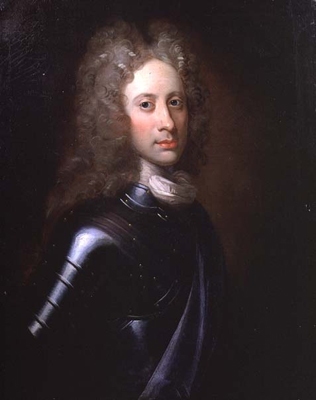
John Campbell, 2nd Duke of Argyll
by William Aikman, 1710 2
by William Aikman, 1710 2
 Field Marshal John Campbell, 2nd Duke of Argyll was born on 10 October 1680 at Ham House, Petersham, Surrey, EnglandG.1 He was the son of Archibald Campbell, 1st Duke of Argyll and Elizabeth Tollemache.1 He married by contract, firstly, Mary Brown, daughter of John Brown and Ursula Duncombe, on 30 December 1701.3 He married, secondly, Jane Warburton, daughter of Thomas Warburton and Anne Williams, on 6 June 1717.3 He and Mary Brown were separated.3 He died on 4 October 1743 at age 62 at Sudbrooke, Surrey, EnglandG, without male issue.1 He was buried on 15 October 1743 at Westminster Abbey, Westminster, London, EnglandG.3 His will was proven (by probate) on 31 October 1743.3
He was Colonel of the 4th troop of the Horse Guards between 1703 and 1715.1 He succeeded as the 12th Lord Campbell [S., 1445] on 25 September 1703.1 He succeeded as the 11th Lord Lorne [S., 1470] on 25 September 1703.1 He succeeded as the 4th Baronet Campbell, of Lundy in Angus, co. Forfar [N.S., 1627] on 25 September 1703.1 He succeeded as the 5th Lord of Kintyre [S., 1626] on 25 September 1703.1 He succeeded as the 11th Earl of Argyll [S., 1457] on 25 September 1703.1 He succeeded as the 2nd Marquess of Kintyre and Lorn [S., 1701] on 25 September 1703.1 He succeeded as the 2nd Duke of Argyll [S., 1701] on 25 September 1703.1 He succeeded as the 2nd Earl of Campbell and Cowall [S., 1701] on 25 September 1703.1 He succeeded as the 2nd Lord of Inverary, Mull, Morvern and Tirie [S., 1701] on 25 September 1703.1 He succeeded as the 2nd Viscount of Lochow and Glenyla [S., 1701] on 25 September 1703.1 He gained the rank of Brigadier-General in 1704.1 He held the office of an Extraordinary Lord of Session between 1704 and 1708.1 He was appointed Knight, Order of the Thistle (K.T.) on 4 February 1703/4.1 He held the office of High Commissioner of the Parliament [Scotland] in 1705.1 He was created 1st Baron of Chatham, Kent on 26 November 1705.1 He was created 1st Earl of Greenwich, Kent [England] on 26 November 1705.1 He gained the rank of Major-General in 1706.1 He was Colonel of the 3rd regiment of Foot (or Buffs) between 1707 and 1711.1 He fought in the campaigns under Marlborough between 1708 and 1710.1 He gained the rank of Lieutenant-General in 1709.1 He was appointed Privy Counsellor (P.C.) on 3 February 1708/9.1 He was appointed Knight, Order of the Garter (K.G.) on 22 December 1710 resigning from the Order of the Thistle at the same time.1 He gained the rank of General in 1711.1 He held the office of Ambassador to King Carlos III of Spain in January 1710/11.1 He held the office of Governor of Edinburgh Castle between 1712 and 1714.1 He held the office of Governor of Minorca between June 1712 and April 1714.1 He held the office of a Lord Justice, Regent of the Realm between 1 August 1714 and 18 September 1714.1 He held the office of Governor of Minorca between 5 October 1714 and 29 June 1716.1 He held the office of Lord-Lieutenant of Dunbartonshire between 1715 and 1743. He held the office of Lord-Lieutenant of Argyllshire between 1715 and 1743.3 He was Colonel of the Royal Horse Guards from 1715 to 1716.1 He held the office of Lord-Lieutenant of Surrey from 1715 to 1716.3 He fought in the Battle of Sheriffmuir on 13 November 1715, where he defeated the adherents of the exiled House of Stuart.3 He held the office of Lord Steward of the Household between 1718 and 1725.3 He was created 1st Duke of Greenwich [Great Britain] on 27 April 1719.3 He held the office of Master-General of the Ordnance between 1725 and 1730.3 He was Colonel of the 3rd Horse (now 2nd Dragoon Guards) between 1726 and 1733.1 He held the office of Governor of Portsmouth between 1730 and 1737.3 He was Colonel of the Royal Horse Guards between 1733 and 1740.1 He gained the rank of Field Marshal on 14 January 1735/36.1 His last will was dated 3 December 1741. He was Colonel of the Royal Horse Guards between February 1742 and March 1742.1 He held the office of Master-General of the Ordnance between February 1742 and March 1742.3
Bishop Burnet remarked "few of his years have a better understanding, nor a more manly behaviour. He has seen most of the courts of Europe; is bery handsome in his person; fair complexioned; about twenty-five years old". Swift states "this great Duke was in his political life but a petty intriguer, a greedy courtier, and a factious patriot."3 According to Horace Walpole, he "was graceful in his figure, ostentatious in his behaviour, impetuous in his passions; prompt to insult, even where he had wit to wound and eloquence to confound; and what is seldom seen, a miser as early as a hero ... He had a great thirst for books, a head admirably turned to mechanics, was a patron of ingenious men, a promoter of discoveries, and one of the first great encouragers of planting in England ... But perhaps too much has been said on the subject of a man who had so little great either in himself or his views ... that poterity will probably interest themselves very slightly in the history of his fortunes."3
As he left no male issue, his English honours ceased on his death (i.e., Duke and Earl of Greenwich, Baron Chatham.)3 He has an extensive biographical entry in the Dictionary of National Biography.4

Children of Field Marshal John Campbell, 2nd Duke of Argyll and Jane Warburton
- Caroline Campbell, Baroness Greenwich+1 b. 17 Nov 1717, d. 11 Jan 1794
- Lady Elizabeth Campbell5 b. a 1718, d. 16 Jul 1799
- Lady unknown daughter Campbell6 b. a 1718
- Lady Anne Campbell7 b. c 1720, d. 7 Feb 1785
- Lady Mary Campbell b. 1727, d. 30 Sep 1811
Citations
- [S6] G.E. Cokayne; with Vicary Gibbs, H.A. Doubleday, Geoffrey H. White, Duncan Warrand and Lord Howard de Walden, editors, The Complete Peerage of England, Scotland, Ireland, Great Britain and the United Kingdom, Extant, Extinct or Dormant, new ed., 13 volumes in 14 (1910-1959; reprint in 6 volumes, Gloucester, U.K.: Alan Sutton Publishing, 2000), volume I, page 206. Hereinafter cited as The Complete Peerage.
- [S3409] Caroline Maubois, "re: Penancoet Family," e-mail message to Darryl Roger Lundy, 2 December 2008. Hereinafter cited as "re: Penancoet Family."
- [S6] Cokayne, and others, The Complete Peerage, volume I, page 207.
- [S18] Matthew H.C.G., editor, Dictionary of National Biography on CD-ROM (Oxford, U.K.: Oxford University Press, 1995), Campbell, John. Hereinafter cited as Dictionary of National Biography.
- [S37] BP2003 volume 1, page 607. See link for full details for this source. Hereinafter cited as. [S37]
- [S37] BP2003. [S37]
- [S6] Cokayne, and others, The Complete Peerage, volume XII/2, page 331.
Reverend James Douglas, 4th Baron Douglas of Douglas1
M, #109652, b. 9 July 1787, d. 6 April 1857
Last Edited=11 Jun 2010
Consanguinity Index=0.62%
Reverend James Douglas, 4th Baron Douglas of Douglas was born on 9 July 1787.1 He was the son of Archibald James Edward Douglas, 1st Baron Douglas of Douglas and Lady Frances Scott.1 He was baptised on 6 August 1787 at Petersham, Surrey, EnglandG.2 He married Wilhelmina Murray, daughter of General Hon. James Murray and Anne Witham, on 18 May 1813.3 He died on 6 April 1857 at age 69 at Bothwell Castle, Lanarkshire, ScotlandG, without issue.2 He was buried at Douglas, ScotlandG.2
He graduated from Christ Church, Oxford University, Oxford, Oxfordshire, EnglandG, in 1810 with a Bachelor of Arts (B.A.)1 He graduated from Christ Church, Oxford University, Oxford, Oxfordshire, EnglandG, in 1816 with a Master of Arts (M.A.)2 He was the Rector between 1819 and 1848 at Marsh Gibbon, Buckinghamshire, EnglandG.1 He was the Rector between 1825 and 1848 at Broughton, Northamptonshire, EnglandG.1 He succeeded as the 4th Baron Douglas of Douglas, co. Lanark [G.B., 1790] on 10 September 1848.4
On his death, the Barony of Douglas of Douglas became extinct.4
He graduated from Christ Church, Oxford University, Oxford, Oxfordshire, EnglandG, in 1810 with a Bachelor of Arts (B.A.)1 He graduated from Christ Church, Oxford University, Oxford, Oxfordshire, EnglandG, in 1816 with a Master of Arts (M.A.)2 He was the Rector between 1819 and 1848 at Marsh Gibbon, Buckinghamshire, EnglandG.1 He was the Rector between 1825 and 1848 at Broughton, Northamptonshire, EnglandG.1 He succeeded as the 4th Baron Douglas of Douglas, co. Lanark [G.B., 1790] on 10 September 1848.4
On his death, the Barony of Douglas of Douglas became extinct.4
Citations
- [S6] G.E. Cokayne; with Vicary Gibbs, H.A. Doubleday, Geoffrey H. White, Duncan Warrand and Lord Howard de Walden, editors, The Complete Peerage of England, Scotland, Ireland, Great Britain and the United Kingdom, Extant, Extinct or Dormant, new ed., 13 volumes in 14 (1910-1959; reprint in 6 volumes, Gloucester, U.K.: Alan Sutton Publishing, 2000), volume I, page 206. Hereinafter cited as The Complete Peerage.
- [S6] Cokayne, and others, The Complete Peerage, volume IV, page 443.
- [S8] BP1999 volume 1, page 1282. See link for full details for this source. Hereinafter cited as. [S8]
- [S37] BP2003 volume 2, page 1743. See link for full details for this source. Hereinafter cited as. [S37]
Wilhelmina Murray1
F, #109653, b. circa 1787, d. 25 February 1866
Last Edited=17 Jan 2010
Wilhelmina Murray was born circa 1787.2 She was the daughter of General Hon. James Murray and Anne Witham.1,2 She married Reverend James Douglas, 4th Baron Douglas of Douglas, son of Archibald James Edward Douglas, 1st Baron Douglas of Douglas and Lady Frances Scott, on 18 May 1813.1 She died on 25 February 1866 at 19 Grosvenor Square, London, EnglandG.2 She was buried at Douglas, ScotlandG.2
From 18 May 1813, her married name became Douglas.1
From 18 May 1813, her married name became Douglas.1
Citations
- [S8] BP1999 volume 1, page 1282. See link for full details for this source. Hereinafter cited as. [S8]
- [S6] G.E. Cokayne; with Vicary Gibbs, H.A. Doubleday, Geoffrey H. White, Duncan Warrand and Lord Howard de Walden, editors, The Complete Peerage of England, Scotland, Ireland, Great Britain and the United Kingdom, Extant, Extinct or Dormant, new ed., 13 volumes in 14 (1910-1959; reprint in 6 volumes, Gloucester, U.K.: Alan Sutton Publishing, 2000), volume IV, page 443. Hereinafter cited as The Complete Peerage.
General Hon. James Murray1
M, #109654, b. 21 January 1722, d. 18 June 1794
Last Edited=29 Mar 2011
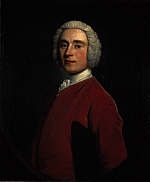
General Hon. James Murray
by Allan Ramsay, 1742 2
by Allan Ramsay, 1742 2
He held the office of Governor of Quebec in 1759.5 He was commander of the left wing of Wolfe's Army taking of Quebec in 1759.5 He held the office of Governor of Canada in 1763.5 He was appointed Companion, Order of the Bath (C.B.)5
Children of General Hon. James Murray and Anne Witham
- Cordelia Murray4 b. 16 Mar 1781, d. 1 May 1849
- Maj.-Gen. James Patrick Murray+5 b. 21 Jan 1782, d. 5 Dec 1834
- Wilhelmina Murray1 b. c 1787, d. 25 Feb 1866
- Anne Harriet Murray4 b. 14 Aug 1788, d. 13 Nov 1850
Citations
- [S8] BP1999 volume 1, page 1282. See link for full details for this source. Hereinafter cited as. [S8]
- [S3409] Caroline Maubois, "re: Penancoet Family," e-mail message to Darryl Roger Lundy, 2 December 2008. Hereinafter cited as "re: Penancoet Family."
- [S4937] Tony Andrews, "re: Murray Family," e-mail message to Darryl Roger LUNDY (101053), 5 October 2010. Hereinafter cited as "re: Murray Family."
- [S37] BP2003 See link for full details for this source. Hereinafter cited as. [S37]
- [S37] BP2003. [S37]
- [S6] G.E. Cokayne; with Vicary Gibbs, H.A. Doubleday, Geoffrey H. White, Duncan Warrand and Lord Howard de Walden, editors, The Complete Peerage of England, Scotland, Ireland, Great Britain and the United Kingdom, Extant, Extinct or Dormant, new ed., 13 volumes in 14 (1910-1959; reprint in 6 volumes, Gloucester, U.K.: Alan Sutton Publishing, 2000), volume IV, page 443. Hereinafter cited as The Complete Peerage.
Lady Jean Keith1
F, #109655
Last Edited=27 Apr 2011
Consanguinity Index=1.49%
Lady Jean Keith is the daughter of John Keith, 1st Earl of Kintore and Lady Margaret Hamilton.1 She married Sir William Forbes of Monymusk, 4th Bt., son of Sir John Forbes of Monymusk, 3rd Bt. and Hon. Margaret Arbuthnott.1
Her married name became Forbes.1
Her married name became Forbes.1
Children of Lady Jean Keith and Sir William Forbes of Monymusk, 4th Bt.
- John Forbes+2 d. 13 Jan 1715
- Mary Forbes+3 b. 1698
Citations
- [S37] BP2003 volume 2, page 2195. See link for full details for this source. Hereinafter cited as. [S37]
- [S37] BP2003. [S37]
- [S3508] S. Thomson, "email: Kirwan Family," e-mail message to Darryl Roger Lundy, 16 January 2009 - 12 February 2010. Hereinafter cited as "email: Kirwan Family."
Robina Lockhart1
F, #109656, b. circa 1662, d. 20 March 1740/41
Last Edited=5 Apr 2014
Robina Lockhart was born circa 1662.2 She was the daughter of Sir William Lockhart, 11th of the Lee and Robina Sewster.1 She married Archibald Douglas, 1st Earl of Forfar, son of Archibald Douglas, Earl of Angus and Jean Wemyss, on 19 August 1679 at Lincoln's Inn Chapel, London, EnglandG.2 She died on 20 March 1740/41 at Bothwell Castle, Lanarkshire, ScotlandG.2
From 19 August 1679, her married name became Douglas.
From 19 August 1679, her married name became Douglas.
Child of Robina Lockhart and Archibald Douglas, 1st Earl of Forfar
- Colonel Archibald Douglas, 2nd Earl of Forfar1 b. 25 May 1692, d. 8 Dec 1715
Citations
- [S8] BP1999 volume 1, page 1282. See link for full details for this source. Hereinafter cited as. [S8]
- [S6] G.E. Cokayne; with Vicary Gibbs, H.A. Doubleday, Geoffrey H. White, Duncan Warrand and Lord Howard de Walden, editors, The Complete Peerage of England, Scotland, Ireland, Great Britain and the United Kingdom, Extant, Extinct or Dormant, new ed., 13 volumes in 14 (1910-1959; reprint in 6 volumes, Gloucester, U.K.: Alan Sutton Publishing, 2000), volume IV, page 443. Hereinafter cited as The Complete Peerage.
Derwenter Radcliffe1
M, #109657, b. 13 February 1802, d. 1 May 1859
Last Edited=6 Apr 2014
Derwenter Radcliffe was born on 13 February 1802.1 He was the son of Edward Radcliffe and Sarah Hall.1 He was baptised on 2 April 1802 at Doncaster, Yorkshire, England.1 He married Lela Anne Gray on 30 July 1823 at St. Thomas, Winchester, Hampshire, England.1 He died on 1 May 1859 at age 57.1
He was a surgeon.1
He was a surgeon.1
Child of Derwenter Radcliffe and Lela Anne Gray
- Frances Douglas Radcliffe1 b. c 1823, d. 21 Dec 1837
Citations
- [S4567] Bill Norton, "re: Pitman Family," e-mail message to Darryl Roger LUNDY (101053), 6 April 2010 and 19 April 2011. Hereinafter cited as "re: Pitman Family."
Robina Sewster1
F, #109658
Last Edited=21 Apr 2014
Robina Sewster was the daughter of John Sewster and Anne Cromwell.1 She married Sir William Lockhart, 11th of the Lee, son of James Lockhart, 10th of the Lee and Martha Douglas.1
Her married name became Lockhart.1
Her married name became Lockhart.1
Children of Robina Sewster and Sir William Lockhart, 11th of the Lee
- Cromwell Lockhart, 12th of the Lee2
- Richard Lockhart, 13th of the Lee2
- John Lockhart, 14th of the Lee+2
- James Lockhart, 15th of the Lee+2 d. 1718
- Martha Lockhart2
- Robina Lockhart+1 b. c 1662, d. 20 Mar 1740/41
John Sewster1
M, #109659
Last Edited=16 Jun 2002
Child of John Sewster and Anne Cromwell
Citations
- [S8] BP1999 volume 1, page 1282. See link for full details for this source. Hereinafter cited as. [S8]
Anne Cromwell1
F, #109660
Last Edited=25 Apr 2008
Child of Anne Cromwell and John Sewster
Citations
- [S8] BP1999 volume 1, page 1282. See link for full details for this source. Hereinafter cited as. [S8]
