




Elizabeth Seymour 
F, #24151, b. 1511, d. 1563
Last Edited=10 Dec 2022
Consanguinity Index=0.0%
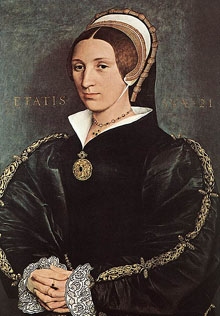
Elizabeth, Baroness Cromwell 1
Her married name became Oughtred.2 From before 1538, her married name became Cromwell.3 From from March 1554 to April 1554, her married name became Paulet.3
Children of Elizabeth Seymour and Gregory Cromwell, 1st Baron Cromwell
- Henry Cromwell, 2nd Baron Cromwell+ d. 20 Nov 1592
- Katherine Cromwell+4
- Frances Cromwell+5 d. 7 Feb 1562
Citations
- [S3409] Caroline Maubois, "re: Penancoet Family," e-mail message to Darryl Roger Lundy, 2 December 2008. Hereinafter cited as "re: Penancoet Family."
- [S37] BP2003 volume 3, page 3679. See link for full details for this source. Hereinafter cited as. [S37]
- [S6] G.E. Cokayne; with Vicary Gibbs, H.A. Doubleday, Geoffrey H. White, Duncan Warrand and Lord Howard de Walden, editors, The Complete Peerage of England, Scotland, Ireland, Great Britain and the United Kingdom, Extant, Extinct or Dormant, new ed., 13 volumes in 14 (1910-1959; reprint in 6 volumes, Gloucester, U.K.: Alan Sutton Publishing, 2000), volume III, page 558. Hereinafter cited as The Complete Peerage.
- [S3899] Cecil Aspinall-Oglander, Nunwell Symphony (London, U.K.: The Hogarth Press, 1946), appendix. Hereinafter cited as Nunwell Symphony.
- [S6289] The History of Parliament Online, online http://www.historyofparliamentonline.org. Hereinafter cited as History of Parliament.
Gregory Cromwell, 1st Baron Cromwell
M, #24152, d. 4 July 1551
Last Edited=10 Dec 2022
Gregory Cromwell, 1st Baron Cromwell was the son of Thomas Cromwell, 1st and last Earl of Essex and Elizabeth Wykes.1,2 He married Elizabeth Seymour, daughter of Sir John Seymour and Marjory Wentworth, before 1538.3 He died on 4 July 1551 at Launde, Leicestershire, EnglandG.3
He was educated at Pembroke College, Cambridge University, Cambridge, Cambridgeshire, England.4 He held the office of Member of Parliament (M.P.) for Kent in 1539.4 He was created 1st Baron Cromwell [England] on 18 December 1540. He was appointed Knight, Order of the Bath (K.B.) on 20 February 1547.4
He was educated at Pembroke College, Cambridge University, Cambridge, Cambridgeshire, England.4 He held the office of Member of Parliament (M.P.) for Kent in 1539.4 He was created 1st Baron Cromwell [England] on 18 December 1540. He was appointed Knight, Order of the Bath (K.B.) on 20 February 1547.4
Children of Gregory Cromwell, 1st Baron Cromwell and Elizabeth Seymour
- Henry Cromwell, 2nd Baron Cromwell+ d. 20 Nov 1592
- Katherine Cromwell+5
- Frances Cromwell+4 d. 7 Feb 1562
Citations
- [S6] G.E. Cokayne; with Vicary Gibbs, H.A. Doubleday, Geoffrey H. White, Duncan Warrand and Lord Howard de Walden, editors, The Complete Peerage of England, Scotland, Ireland, Great Britain and the United Kingdom, Extant, Extinct or Dormant, new ed., 13 volumes in 14 (1910-1959; reprint in 6 volumes, Gloucester, U.K.: Alan Sutton Publishing, 2000), volume III, page 555. Hereinafter cited as The Complete Peerage.
- [S6] Cokayne, and others, The Complete Peerage, volume III, page 557.
- [S6] Cokayne, and others, The Complete Peerage, volume III, page 558.
- [S6289] The History of Parliament Online, online http://www.historyofparliamentonline.org. Hereinafter cited as History of Parliament.
- [S3899] Cecil Aspinall-Oglander, Nunwell Symphony (London, U.K.: The Hogarth Press, 1946), appendix. Hereinafter cited as Nunwell Symphony.
Henry Arundell, 7th Baron Arundell of Wardour1
M, #24153, b. 4 October 1717, d. 12 September 1756
Last Edited=9 Feb 2011
Henry Arundell, 7th Baron Arundell of Wardour was born on 4 October 1717.1,2 He was the son of Henry Arundell, 6th Baron Arundell of Wardour and Elizabeth Eleanor Everard.1 He was also reported to have been born on 4 March 1717/18.1 He married Mary Bellings-Arundell, daughter of Richard Bellings-Arundell and Anne Gage, on 27 January 1738/39, with a dower of £70,000.1 He died on 12 September 1756 at age 38 at Wardour Castle, Wiltshire, EnglandG.1 He was buried on 22 September 1756 at Tisbury, Wiltshire, EnglandG.1 His will was proven (by probate) on 26 January 1757, by Mary, the widow and universal legatee.1
His last will was dated between 10 May 1739 and 27 February 1754. He succeeded as the 7th Baron Arundell of Wardour, co. Wiltshire [E., 1605] on 30 June 1746.1
His last will was dated between 10 May 1739 and 27 February 1754. He succeeded as the 7th Baron Arundell of Wardour, co. Wiltshire [E., 1605] on 30 June 1746.1
Child of Henry Arundell, 7th Baron Arundell of Wardour and Mary Bellings-Arundell
- Henry Arundell, 8th Baron Arundell of Wardour+1 b. 31 Mar 1740, d. 4 Dec 1808
Citations
- [S6] G.E. Cokayne; with Vicary Gibbs, H.A. Doubleday, Geoffrey H. White, Duncan Warrand and Lord Howard de Walden, editors, The Complete Peerage of England, Scotland, Ireland, Great Britain and the United Kingdom, Extant, Extinct or Dormant, new ed., 13 volumes in 14 (1910-1959; reprint in 6 volumes, Gloucester, U.K.: Alan Sutton Publishing, 2000), volume I, page 266. Hereinafter cited as The Complete Peerage.
- [S21] L. G. Pine, The New Extinct Peerage 1884-1971: Containing Extinct, Abeyant, Dormant and Suspended Peerages With Genealogies and Arms (London, U.K.: Heraldry Today, 1972), page 11. Hereinafter cited as The New Extinct Peerage.
Dorothy Seymour1
F, #24154
Last Edited=14 Dec 2019
Consanguinity Index=0.0%
Dorothy Seymour is the daughter of Sir John Seymour and Marjory Wentworth.1 She married, firstly, Sir Clement Smyth.2 She married, secondly, Thomas Levinthorpe after 1562.2
Her married name became Smyth.2 From after 1562, her married name became Levinthorpe.2
Her married name became Smyth.2 From after 1562, her married name became Levinthorpe.2
Children of Dorothy Seymour and Sir Clement Smyth
Mary Bellings-Arundell1
F, #24155, b. 1716, d. 21 February 1769
Last Edited=23 Dec 2009
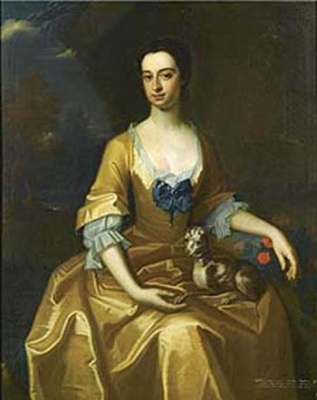
Mary Bellings-Arundell 2
From 27 January 1738/39, her married name became Arundell.1 After her marriage, Mary Bellings-Arundell was styled as Baroness Arundell of Wardour on 30 June 1746. Her last will was dated 6 June 1767.
Child of Mary Bellings-Arundell and Henry Arundell, 7th Baron Arundell of Wardour
- Henry Arundell, 8th Baron Arundell of Wardour+1 b. 31 Mar 1740, d. 4 Dec 1808
Citations
- [S6] G.E. Cokayne; with Vicary Gibbs, H.A. Doubleday, Geoffrey H. White, Duncan Warrand and Lord Howard de Walden, editors, The Complete Peerage of England, Scotland, Ireland, Great Britain and the United Kingdom, Extant, Extinct or Dormant, new ed., 13 volumes in 14 (1910-1959; reprint in 6 volumes, Gloucester, U.K.: Alan Sutton Publishing, 2000), volume I, page 266. Hereinafter cited as The Complete Peerage.
- [S3409] Caroline Maubois, "re: Penancoet Family," e-mail message to Darryl Roger Lundy, 2 December 2008. Hereinafter cited as "re: Penancoet Family."
Richard Bellings-Arundell1
M, #24156
Last Edited=6 Sep 2020
Richard Bellings-Arundell was the son of Sir Richard Bellings and Frances Arundell.1 He married Anne Gage, daughter of Joseph Gage and Elizabeth Penruddock.2
He lived at Lanherne, Cornwall, EnglandG.1
He lived at Lanherne, Cornwall, EnglandG.1
Children of Richard Bellings-Arundell and Anne Gage
- Frances Bellings-Arundell3 b. 1704, d. 8 Feb 1752
- Mary Bellings-Arundell+1 b. 1716, d. 21 Feb 1769
Citations
- [S6] G.E. Cokayne; with Vicary Gibbs, H.A. Doubleday, Geoffrey H. White, Duncan Warrand and Lord Howard de Walden, editors, The Complete Peerage of England, Scotland, Ireland, Great Britain and the United Kingdom, Extant, Extinct or Dormant, new ed., 13 volumes in 14 (1910-1959; reprint in 6 volumes, Gloucester, U.K.: Alan Sutton Publishing, 2000), volume I, page 266. Hereinafter cited as The Complete Peerage.
- [S37] BP2003 volume 2, page 1500. See link for full details for this source. Hereinafter cited as. [S37]
- [S8885] Colin Perry, "re: Fenwick Family," e-mail message to Darryl Roger LUNDY (101053), 26 Dec 2019. Hereinafter cited as "re: Fenwick Family."
Sir Edward Seymour1
M, #24157, b. between 1527 and 1535, d. 6 May 1593
Last Edited=6 Nov 2017
Sir Edward Seymour was born between 1527 and 1535. He was the son of Edward Seymour, 1st Duke of Somerset and Catherine Filliol.1 He married Margaret Walsh, daughter of John Walsh.1 He died on 6 May 1593.1
He fought in the Battle of Pinkie on 10 September 1547.1 He was appointed Knight on 18 September 1547.1 In 1553 he was restored in blood by an Act of Parliament.1 On 6 September 1553 he was granted the manors of Walton, Shedder and Stowey, Somerset.1 He held the office of Sheriff of Devon in 1583.1 He lived at Berry Pomeroy, Devon, EnglandG.1
He fought in the Battle of Pinkie on 10 September 1547.1 He was appointed Knight on 18 September 1547.1 In 1553 he was restored in blood by an Act of Parliament.1 On 6 September 1553 he was granted the manors of Walton, Shedder and Stowey, Somerset.1 He held the office of Sheriff of Devon in 1583.1 He lived at Berry Pomeroy, Devon, EnglandG.1
Child of Sir Edward Seymour and Margaret Walsh
- Sir Edward Seymour, 1st Bt.+1 b. c 1556, d. 11 Apr 1613
Citations
- [S37] BP2003 volume 3, page 3679. See link for full details for this source. Hereinafter cited as. [S37]
Sir William Filliol1
M, #24158, d. 9 July 1536
Last Edited=23 Oct 2017
Child of Sir William Filliol and Dorothy Ifield
Citations
- [S37] BP2003 volume 3, page 3679. See link for full details for this source. Hereinafter cited as. [S37]
- [S1916] Tim Boyle, "re: Boyle Family," e-mail message to Darryl Roger Lundy, 16 September 2006. Hereinafter cited as "re: Boyle Family."
Sir Richard Bellings1
M, #24159
Last Edited=6 Oct 2003
Child of Sir Richard Bellings and Frances Arundell
Citations
- [S6] G.E. Cokayne; with Vicary Gibbs, H.A. Doubleday, Geoffrey H. White, Duncan Warrand and Lord Howard de Walden, editors, The Complete Peerage of England, Scotland, Ireland, Great Britain and the United Kingdom, Extant, Extinct or Dormant, new ed., 13 volumes in 14 (1910-1959; reprint in 6 volumes, Gloucester, U.K.: Alan Sutton Publishing, 2000), volume I, page 266. Hereinafter cited as The Complete Peerage.
Sir Edward Stanhope1
M, #24160, d. 6 June 1512
Last Edited=15 Mar 2007
Sir Edward Stanhope was the son of Sir Thomas Stanhope and Mary Jerningham.1 He married, secondly, Elizabeth Bourchier, daughter of Fulk Bourchier, 10th Lord FitzWarin.1 He married, firstly, Avelina Clifton, daughter of Sir Gervase Clifton.1 He died on 6 June 1512.1
He fought in the Battle of Stoke in 1487, as commander of the Royal army.1 He was appointed Knight in 1497.1 He fought in the Battle of Blackheath in 1497.1 He lived at Rampton, Nottinghamshire, EnglandG.1
He fought in the Battle of Stoke in 1487, as commander of the Royal army.1 He was appointed Knight in 1497.1 He fought in the Battle of Blackheath in 1497.1 He lived at Rampton, Nottinghamshire, EnglandG.1
Child of Sir Edward Stanhope and Elizabeth Bourchier
- Anne Stanhope+1 b. c 1497, d. 16 Apr 1587
Children of Sir Edward Stanhope and Avelina Clifton
- Richard Stanhope+1 b. 1502, d. 1583
- Sir Michael Stanhope+1 b. bt 1502 - 1512, d. 25 Feb 1552
Citations
- [S21] L. G. Pine, The New Extinct Peerage 1884-1971: Containing Extinct, Abeyant, Dormant and Suspended Peerages With Genealogies and Arms (London, U.K.: Heraldry Today, 1972), page 65. Hereinafter cited as The New Extinct Peerage.
