




Sir Thomas Kitson1 
M, #105961, d. 11 September 1540
Last Edited=8 Aug 2024
Sir Thomas Kitson was the son of Robert Kytson.2 He married Margaret Donington, daughter of John Donington and Elizabeth Pye, before 1540.1 He died on 11 September 1540.1
He lived at Hengrave, Suffolk, EnglandG.1
He lived at Hengrave, Suffolk, EnglandG.1
Child of Sir Thomas Kitson
Children of Sir Thomas Kitson and Margaret Donington
- Frances Kitson+1 d. c Mar 1586
- Sir Thomas Kitson+4 d. 1603
- Anne Kitson5
Citations
- [S6] G.E. Cokayne; with Vicary Gibbs, H.A. Doubleday, Geoffrey H. White, Duncan Warrand and Lord Howard de Walden, editors, The Complete Peerage of England, Scotland, Ireland, Great Britain and the United Kingdom, Extant, Extinct or Dormant, new ed., 13 volumes in 14 (1910-1959; reprint in 6 volumes, Gloucester, U.K.: Alan Sutton Publishing, 2000), volume II, page 17. Hereinafter cited as The Complete Peerage.
- [S60] Charles and Hugh Brogan Mosley, editor, American Presidential Families (London, U.K.: Alan Sutton and Morris Genealogical Books, 1994), page 48. Hereinafter cited as American Presidential Families.
- [S6] Cokayne, and others, The Complete Peerage, volume VI, page 629.
- [S6995] Mary Galloway, "re: Davely Family," e-mail message to Darryl Roger LUNDY (101053), 27 January 2014. Hereinafter cited as "re: Davenly Family."
- [S229] Burke John and John Bernard Burke, A Genealogical and Heraldic History of the Extinct and Dormant Baronetcies of England (1841, reprint; Baltimore, Maryland, USA: Genealogical Publishing Company, 1985), page 501. Hereinafter cited as Extinct and Dormant Baronetcies of England.
Lady Penelope Spencer1
F, #105962, b. circa January 1644, d. circa 1645
Last Edited=22 May 2004
Consanguinity Index=0.58%
Lady Penelope Spencer was born circa January 1644.1 She was the daughter of Henry Spencer, 1st Earl of Sunderland and Lady Dorothy Sydney.1 She died circa 1645.1
Citations
- [S10] John Pearson, Blood Royal: The Story of the Spencers and the Royals (London, U.K.: HarperCollins, 1999), endpiece. Hereinafter cited as Blood Royal.
Lady Dorothy Spencer1
F, #105963, b. 1640, d. 16 December 1670
Last Edited=4 Dec 2012
Consanguinity Index=0.58%
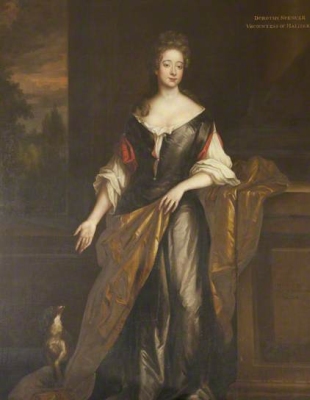
Lady Dorothy, Marchioness of Halifax
by Jan van der Vaart 2
by Jan van der Vaart 2
From 29 December 1656, her married name became Saville.
Children of Lady Dorothy Spencer and George Saville, 1st Marquess of Halifax
- Lady Anne Saville+ b. 1663, d. c Jan 1689/90
- William Saville, 2nd Marquess of Halifax+ b. 1665, d. 31 Aug 1700
Citations
- [S10] John Pearson, Blood Royal: The Story of the Spencers and the Royals (London, U.K.: HarperCollins, 1999), endpiece. Hereinafter cited as Blood Royal.
- [S3409] Caroline Maubois, "re: Penancoet Family," e-mail message to Darryl Roger Lundy, 2 December 2008. Hereinafter cited as "re: Penancoet Family."
- [S6] G.E. Cokayne; with Vicary Gibbs, H.A. Doubleday, Geoffrey H. White, Duncan Warrand and Lord Howard de Walden, editors, The Complete Peerage of England, Scotland, Ireland, Great Britain and the United Kingdom, Extant, Extinct or Dormant, new ed., 13 volumes in 14 (1910-1959; reprint in 6 volumes, Gloucester, U.K.: Alan Sutton Publishing, 2000), volume VII, page 243. Hereinafter cited as The Complete Peerage.
George Saville, 1st Marquess of Halifax1
M, #105964, b. 11 November 1633, d. 5 April 1695
Last Edited=18 Jun 2023
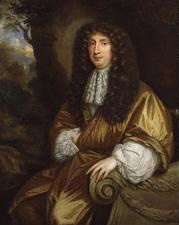
George Saville, 1st Marquess of Halifax
by Mary Beale, 1674 2
by Mary Beale, 1674 2
 George Saville, 1st Marquess of Halifax was born on 11 November 1633.3 He was the son of Sir William Savile, 3rd Bt. and Hon. Anne Coventry.4 He married, firstly, Lady Dorothy Spencer, daughter of Henry Spencer, 1st Earl of Sunderland and Lady Dorothy Sydney, on 29 December 1656 at St. Gile's-in-the-Fields Church, London, EnglandG.5 He married, secondly, Gertrude Pierrepont, daughter of Hon. William Pierrepont, in November 1672. He died on 5 April 1695 at age 61.
Also an early promoter of English sea power.3 He lived Rufford.3 He was Captain of Horse.3 (stripped of membership by JAMES II for hostility to the repeal of the Test Acts.3 He was educated at Oxford University, Oxford, Oxfordshire, EnglandG.3 He succeeded as the 4th Baronet Savile, of Thornhill, co. York [E., 1611] on 24 January 1644.3 He held the office of Member of Parliament (M.P.) for Pontefract in 1660.3 He was created 1st Viscount Halifax [England] on 13 January 1668. He was Commissioner of Trade in 1669.3 He was appointed Privy Counsellor (P.C.) from 1672 to January 1675/76.3 He was appointed Fellow, Royal Society (F.R.S.) in 1675.3 He was created 1st Earl of Halifax [England] on 16 July 1679. He held the office of Lord Privy Seal from 1682 to February 1684/85.3 He was created 1st Marquess of Halifax [England] on 17 August 1682. He was Chancellor to Queen Catherine of Braganza from 1684 to 1685.3 He held the office of Lord President of the Council from February 1685 to December 1685. He held the office of Speaker of the House of Lords from January 1689 to December 1689. He held the office of Lord Privy Seal from February 1688/89 to February 1689/90.3
Child of George Saville, 1st Marquess of Halifax
- Henry Carey+ d. 4 Oct 1743
Children of George Saville, 1st Marquess of Halifax and Lady Dorothy Spencer
- Lady Anne Saville+6 b. 1663, d. c Jan 1689/90
- William Saville, 2nd Marquess of Halifax+ b. 1665, d. 31 Aug 1700
Child of George Saville, 1st Marquess of Halifax and Gertrude Pierrepont
- Lady Elizabeth Saville+7 b. 28 Aug 1675, d. 6 Sep 1708
Citations
- [S10] John Pearson, Blood Royal: The Story of the Spencers and the Royals (London, U.K.: HarperCollins, 1999), endpiece. Hereinafter cited as Blood Royal.
- [S3409] Caroline Maubois, "re: Penancoet Family," e-mail message to Darryl Roger Lundy, 2 December 2008. Hereinafter cited as "re: Penancoet Family."
- [S37] BP2003 volume 2, page 2673. See link for full details for this source. Hereinafter cited as. [S37]
- [S37] BP2003. [S37]
- [S6] G.E. Cokayne; with Vicary Gibbs, H.A. Doubleday, Geoffrey H. White, Duncan Warrand and Lord Howard de Walden, editors, The Complete Peerage of England, Scotland, Ireland, Great Britain and the United Kingdom, Extant, Extinct or Dormant, new ed., 13 volumes in 14 (1910-1959; reprint in 6 volumes, Gloucester, U.K.: Alan Sutton Publishing, 2000), volume VII, page 243. Hereinafter cited as The Complete Peerage.
- [S6] Cokayne, and others, The Complete Peerage, volume II, page 213.
- [S6] Cokayne, and others, The Complete Peerage, volume III, page 182.
Lady Elizabeth Spencer1
F, #105965, b. circa 1673, d. June 1704
Last Edited=21 Jan 2007
Consanguinity Index=0.03%
Lady Elizabeth Spencer was born circa 1673.2 She was the daughter of Robert Spencer, 2nd Earl of Sunderland and Lady Anne Digby.2,1 She married Donogh MacCarty, 4th Earl of Clancarty, son of Callaghan MacCarty, 3rd Earl of Clancarty and Lady Elizabeth FitzGerald, on 31 December 1684 at Westminster Abbey, Westminster, London, EnglandG.2 She died in June 1704.3
After her marriage, Lady Elizabeth Spencer was styled as Countess of Clancarty on 31 December 1684. From 31 December 1684, her married name became MacCarty.1
After her marriage, Lady Elizabeth Spencer was styled as Countess of Clancarty on 31 December 1684. From 31 December 1684, her married name became MacCarty.1
Children of Lady Elizabeth Spencer and Donogh MacCarty, 4th Earl of Clancarty
- Lady Charlotte MacCarthy+1 d. 7 Feb 1734/35
- Robert MacCarty, Viscount Muskerry+2 b. 1685, d. 19 Sep 1769
Citations
- [S6] G.E. Cokayne; with Vicary Gibbs, H.A. Doubleday, Geoffrey H. White, Duncan Warrand and Lord Howard de Walden, editors, The Complete Peerage of England, Scotland, Ireland, Great Britain and the United Kingdom, Extant, Extinct or Dormant, new ed., 13 volumes in 14 (1910-1959; reprint in 6 volumes, Gloucester, U.K.: Alan Sutton Publishing, 2000), volume IV, page 162. Hereinafter cited as The Complete Peerage.
- [S6] Cokayne, and others, The Complete Peerage, volume III, page 217.
- [S6] Cokayne, and others, The Complete Peerage, volume III, page 216.
Donogh MacCarty, 4th Earl of Clancarty1
M, #105966, b. circa 1668, d. 1 October 1734
Last Edited=18 Sep 2007
Consanguinity Index=0.12%
Donogh MacCarty, 4th Earl of Clancarty was born circa 1668.1 He was the son of Callaghan MacCarty, 3rd Earl of Clancarty and Lady Elizabeth FitzGerald.2 He married Lady Elizabeth Spencer, daughter of Robert Spencer, 2nd Earl of Sunderland and Lady Anne Digby, on 31 December 1684 at Westminster Abbey, Westminster, London, EnglandG.1 He died on 1 October 1734 at island in the Elbe, Altona, GermanyG.1
He succeeded as the 4th Baronet MacCarty [N.S., c. 1638] on 21 November 1676.2 He succeeded as the 4th Earl of Clancarty, co. Cork [I., 1658] on 21 November 1676.2 He succeeded as the 5th Viscount Muskerry [I., 1628] on 21 November 1676.2 He was commander of the Regiment of Infantry in 1689.1 He held the office of Lord of the Bedchamber to King James II in 1689, in Ireland.2 He fought in the Siege of Cork in 1690, where he was captured and confined to the Tower. He subsequently fled to France in May 1694.1 On 11 May 1691 he was attainted and his estates and titles forfeited.1 He was commander of the troop of Horse Guards in France between 1694 and 1697.1 In 1698 he secretly returned to England, was betrayed by his brother-in-law, Charles, Lord Spencer, and was again imprisoned in the Tower. lady Russell obatiend a pardon for him, on condition he stayed permanently abroad.1 He was Lord of the Bedchamber to the titular King James III on 4 August 1707.1
He succeeded as the 4th Baronet MacCarty [N.S., c. 1638] on 21 November 1676.2 He succeeded as the 4th Earl of Clancarty, co. Cork [I., 1658] on 21 November 1676.2 He succeeded as the 5th Viscount Muskerry [I., 1628] on 21 November 1676.2 He was commander of the Regiment of Infantry in 1689.1 He held the office of Lord of the Bedchamber to King James II in 1689, in Ireland.2 He fought in the Siege of Cork in 1690, where he was captured and confined to the Tower. He subsequently fled to France in May 1694.1 On 11 May 1691 he was attainted and his estates and titles forfeited.1 He was commander of the troop of Horse Guards in France between 1694 and 1697.1 In 1698 he secretly returned to England, was betrayed by his brother-in-law, Charles, Lord Spencer, and was again imprisoned in the Tower. lady Russell obatiend a pardon for him, on condition he stayed permanently abroad.1 He was Lord of the Bedchamber to the titular King James III on 4 August 1707.1
Children of Donogh MacCarty, 4th Earl of Clancarty and Lady Elizabeth Spencer
- Lady Charlotte MacCarthy+3 d. 7 Feb 1734/35
- Robert MacCarty, Viscount Muskerry+1 b. 1685, d. 19 Sep 1769
Citations
- [S6] G.E. Cokayne; with Vicary Gibbs, H.A. Doubleday, Geoffrey H. White, Duncan Warrand and Lord Howard de Walden, editors, The Complete Peerage of England, Scotland, Ireland, Great Britain and the United Kingdom, Extant, Extinct or Dormant, new ed., 13 volumes in 14 (1910-1959; reprint in 6 volumes, Gloucester, U.K.: Alan Sutton Publishing, 2000), volume III, page 217. Hereinafter cited as The Complete Peerage.
- [S6] Cokayne, and others, The Complete Peerage, volume III, page 216.
- [S37] BP2003 volume 1, page 1075. See link for full details for this source. Hereinafter cited as. [S37]
Lady Anne Spencer1
F, #105967, b. 24 June 1667, d. 2 July 1690
Last Edited=22 Dec 2014
Consanguinity Index=0.03%
Anne, Duchess of Hamilton
by Godfrey Kneller 2
by Godfrey Kneller 2
Lady Anne Spencer was born on 24 June 1667 however Blood Royal states 1667, and the 1666 date seems unlikely given the May 1666 birthdate for her brother, Robert.3 She was baptised in June 1667 at Brington, Northamptonshire, EnglandG.3 She was the daughter of Robert Spencer, 2nd Earl of Sunderland and Lady Anne Digby.1 She married Lt.-Gen. James Hamilton, 4th Duke of Hamilton, son of William Douglas-Hamilton, 1st Earl of Selkirk and Anne Hamilton, 3rd Duchess of Hamilton, on 5 January 1686/87.3 She died on 2 July 1690 at age 23 without male issue.3 She was buried at Hamilton, ScotlandG.3Evelyn describes her in 1688 as "a young lady of admirable accomplishments and virtue."3
Citations
- [S10] John Pearson, Blood Royal: The Story of the Spencers and the Royals (London, U.K.: HarperCollins, 1999), endpiece. Hereinafter cited as Blood Royal.
- [S3409] Caroline Maubois, "re: Penancoet Family," e-mail message to Darryl Roger Lundy, 2 December 2008. Hereinafter cited as "re: Penancoet Family."
- [S6] G.E. Cokayne; with Vicary Gibbs, H.A. Doubleday, Geoffrey H. White, Duncan Warrand and Lord Howard de Walden, editors, The Complete Peerage of England, Scotland, Ireland, Great Britain and the United Kingdom, Extant, Extinct or Dormant, new ed., 13 volumes in 14 (1910-1959; reprint in 6 volumes, Gloucester, U.K.: Alan Sutton Publishing, 2000), volume VI, page 268. Hereinafter cited as The Complete Peerage.
Lt.-Gen. James Hamilton, 4th Duke of Hamilton1
M, #105968, b. 11 April 1658, d. 15 November 1712
Last Edited=27 Feb 2013
Consanguinity Index=0.93%
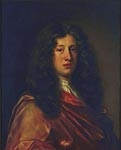
James Hamilton, 4th Duke of Hamilton
by Ferdinand Voet 2
by Ferdinand Voet 2
Lt.-Gen. James Hamilton, 4th Duke of Hamilton was born on 11 April 1658.1 He was the son of William Douglas-Hamilton, 1st Earl of Selkirk and Anne Hamilton, 3rd Duchess of Hamilton.1 He married, firstly, Lady Anne Spencer, daughter of Robert Spencer, 2nd Earl of Sunderland and Lady Anne Digby, on 5 January 1686/87.3 He married, secondly, Elizabeth Gerard, daughter of Digby Gerard, 5th Baron Gerard of Gerard's Bromley and Lady Elizabeth Gerard, on 17 July 1698 at Bushey Park, London, EnglandG.3 He died on 15 November 1712 at age 54 at Hyde Park, St. James's, London, EnglandG, killed in a duel with Lord Mohun, who was also killed.3 He was buried on 29 October 1718 at Hamilton, ScotlandG.4 He was buried at Westminster Abbey, Westminster, London, EnglandG, temporarily.He was styled as Earl of Arran between 1658 and 1698.1 He was educated at University of Glasgow, Glasgow, Lanarkshire, ScotlandG.1 He held the office of Gentleman of the Bedchamber between 1679 and 1688.1 He held the office of Envoy to Paris between 1683 and 1685.1 He gained the rank of Colonel in 1685 in the 6th Horse.5 He held the office of Envoy to Paris in September 1686.1 He was appointed Knight, Order of the Thistle (K.T.) on 29 May 1687.1 He gained the rank of Brigadier-General in 1688.5 He held the office of Master of the Great Wardrobe from 1688 to 1689.5 On 18 December 1688 , when King James II was elected from Whitehall, he was one of the four peers who accompanied him to Rochester, consequently being on the side opposed to his own father.5 He and Barbara Fitzroy were associated circa 1690.6 He gained the rank of Lieutenant-General in 1693.5 He succeeded as the 4th Marquess of Clydesdale [S., 1643] on 9 July 1698.1 He succeeded as the 4th Duke of Hamilton [S., 1643] on 9 July 1698.1 He succeeded as the 3rd Earl of Lanark [S., 1639] on 9 July 1698.5 He succeeded as the 3rd Lord Machansyre and Polmont [S., 1639] on 9 July 1698.5 He succeeded as the 4th Lord Aven and Innerdale [S., 1643] on 9 July 1698.1 He succeeded as the 4th Earl of Arran and Cambridge [S., 1643] on 9 July 1698.5 He held the office of Gentleman of the Bedchamber between 1699 and 1702.1 On 21 May 1700 he took his oath and seat in the Scottish Parliament. While he was a strong opponent of the Union [Scotland], he took no part in the contemplated insurrection.5 He held the office of Representative Peer [Scotland] between 1708 and 1712.5 In March 1707/8 he was suspected of abetting the abortive invasion of Scotland by the French in the Jacobite interest, was apprehended at Ashton, Lancashire, and brought to London, although no evidence could be obtained against him.5 He held the office of Lord-Lieutenant of Lancashire between 1710 and 1712.5 He was appointed Privy Counsellor (P.C.) on 13 December 1710.5 He was created 1st Duke of Brandon [Great Britain] on 10 September 1711.5 He was created 1st Baron of Dutton [Great Britain] on 10 September 1711.5 On 29 August 1712 he was appointed as Ambassador to Paris, but never actually took up the position due to his untimely death.3 He held the office of Master General of the Ordnance in September 1712.3 He was appointed Knight, Order of the Garter (K.G.) on 26 October 1712.3 He has an extensive biographical entry in the Dictionary of National Biography.7

Cockayne writes that "the duel with Lord Mohun was occasioned by a dispute regarding the division of the Gawsworth estate, to which his wife and Lady Mohun were coheirs. In a contemporary letter, penned from London within a week of the duel, the writer states of the Duke 'I assure that he has more friends at present than ever he had while alive'. Macky wrote of him 'on the Queen's accession he made strong efforts to get into administration, but has not yet succeeded, though he is well received at Court; he is brave in his person, with a rough air of boldness; of good sense, very forward and hot for what he undertakes, ambitious and haughty; a violent enemy, has been very extravegent in his manner of living, but not grown covetous; he is supposed to have some thoughts towards the Crown of England when the Queen dies, beign descended from the house of Stuart, &c. Has a great estate, is of a middle stature, well made, of a black coarse complexion, and a brisk look.4' " Cockayne then quotes Dean Swift " 'he was made master of the ordnance; a worthy good natured person, very generous but of a middle understanding; he was murdered by that villain Macarney, an Irish Scot'. Bishop Burnet, who knew him well, says 'I will add no character of him; I am sorry I cannot say so much good of him as I could wish, and I had too much kindness for him to say any evil without necessity.4' "
Child of Lt.-Gen. James Hamilton, 4th Duke of Hamilton
- Lt.-Col. Sir James Abercrombie, 1st Bt.8 b. b 1680, d. 14 Nov 1724
Child of Lt.-Gen. James Hamilton, 4th Duke of Hamilton and Barbara Fitzroy
- Charles Hamilton, Comte d'Arran+6 b. 30 Mar 1691, d. 13 Aug 1754
Children of Lt.-Gen. James Hamilton, 4th Duke of Hamilton and Elizabeth Gerard
- Lord William Hamilton9 b. bt 1699 - 1712, d. 11 Jun 1734
- Lady Elizabeth Hamilton10 b. 1700, d. 2 Apr 1702
- Lady Catherine Hamilton10 b. 1701, d. 22 Dec 1712
- Lady Susan Hamilton+10 b. bt 1702 - 1712, d. 3 Jun 1755
- James Hamilton, 5th Duke of Hamilton+4 b. 5 Jan 1702/3, d. 2 Mar 1742/43
- Lady Charlotte Hamilton10 b. c 1707, d. 5 Feb 1777
- Lord Anne Hamilton+11 b. 12 Oct 1709, d. 25 Dec 1748
Citations
- [S6] G.E. Cokayne; with Vicary Gibbs, H.A. Doubleday, Geoffrey H. White, Duncan Warrand and Lord Howard de Walden, editors, The Complete Peerage of England, Scotland, Ireland, Great Britain and the United Kingdom, Extant, Extinct or Dormant, new ed., 13 volumes in 14 (1910-1959; reprint in 6 volumes, Gloucester, U.K.: Alan Sutton Publishing, 2000), volume VI, page 266. Hereinafter cited as The Complete Peerage.
- [S3409] Caroline Maubois, "re: Penancoet Family," e-mail message to Darryl Roger Lundy, 2 December 2008. Hereinafter cited as "re: Penancoet Family."
- [S6] Cokayne, and others, The Complete Peerage, volume VI, page 268.
- [S6] Cokayne, and others, The Complete Peerage, volume VI, page 269.
- [S6] Cokayne, and others, The Complete Peerage, volume VI, page 267.
- [S3436] Allen Andrews, The Royal Whore: Barbara Villiers, Lasy Castlemaine (n.n.: Chilton Book Company, 1970). Hereinafter cited as The Royal Whore.
- [S18] Matthew H.C.G., editor, Dictionary of National Biography on CD-ROM (Oxford, U.K.: Oxford University Press, 1995). Hereinafter cited as Dictionary of National Biography.
- [S15] George Edward Cokayne, editor, The Complete Baronetage, 5 volumes (no date (c. 1900); reprint, Gloucester, U.K.: Alan Sutton Publishing, 1983), volume V, page 8. Hereinafter cited as The Complete Baronetage.
- [S8] BP1999 volume 1, page 1284. See link for full details for this source. Hereinafter cited as. [S8]
- [S8] BP1999. [S8]
- [S6] Cokayne, and others, The Complete Peerage, volume VI, page 270.
Mary Gould1
F, #105969, b. 1676, d. 10 January 1757
Last Edited=2 May 2023
Mary Gould was baptised in 1676.2 She was the daughter of James Gould and Mary Bonde.1 She married, firstly, Lt.-Gen. Charles Churchill, son of Sir Winston Churchill and Elizabeth Drake, in 1702.1 She married, secondly, Montagu Venables-Bertie, 2nd Earl of Abingdon, son of James Bertie, 1st Earl of Abingdon and Eleanora Lee, on 13 February 1716/17 at Beaconsfield, Buckinghamshire, EnglandG.1 She died on 10 January 1757 in an accident where she was burnt to death.3 Her will (dated 3 March 1742) was proven (by probate) on 20 June 1757.3
Her married name became Churchill. After her marriage, Mary Gould was styled as Countess of Abingdon on 13 February 1716/17. Her married name became Bertie.
Hearne describes her as "a woman of great virtue."4
Her married name became Churchill. After her marriage, Mary Gould was styled as Countess of Abingdon on 13 February 1716/17. Her married name became Bertie.
Hearne describes her as "a woman of great virtue."4
Child of Mary Gould and Montagu Venables-Bertie, 2nd Earl of Abingdon
- James Bertie, Lord Norreys b. 14 Nov 1717, d. 25 Feb 1717/18
Citations
- [S8] BP1999 volume 2, page 1866. See link for full details for this source. Hereinafter cited as. [S8]
- [S40] L. G. Pine, editor, Burke's Genealogical and Heraldic History of the Landed Gentry, 17th edition, (London, England: Burke's Peerage Ltd, 1952), page 1030. Hereinafter cited as Burke's Landed Gentry, 17th ed.
- [S6] G.E. Cokayne; with Vicary Gibbs, H.A. Doubleday, Geoffrey H. White, Duncan Warrand and Lord Howard de Walden, editors, The Complete Peerage of England, Scotland, Ireland, Great Britain and the United Kingdom, Extant, Extinct or Dormant, new ed., 13 volumes in 14 (1910-1959; reprint in 6 volumes, Gloucester, U.K.: Alan Sutton Publishing, 2000), volume I, page 47. Hereinafter cited as The Complete Peerage.
- [S6] Cokayne, and others, The Complete Peerage, volume I, page 48.
James Gould1
M, #105970, d. 1707
Last Edited=2 May 2023
Child of James Gould and Mary Bonde
- Mary Gould+1 b. 1676, d. 10 Jan 1757
Citations
- [S8] BP1999 volume 2, page 1866. See link for full details for this source. Hereinafter cited as. [S8]
- [S40] L. G. Pine, editor, Burke's Genealogical and Heraldic History of the Landed Gentry, 17th edition, (London, England: Burke's Peerage Ltd, 1952), page 1030. Hereinafter cited as Burke's Landed Gentry, 17th ed.
